
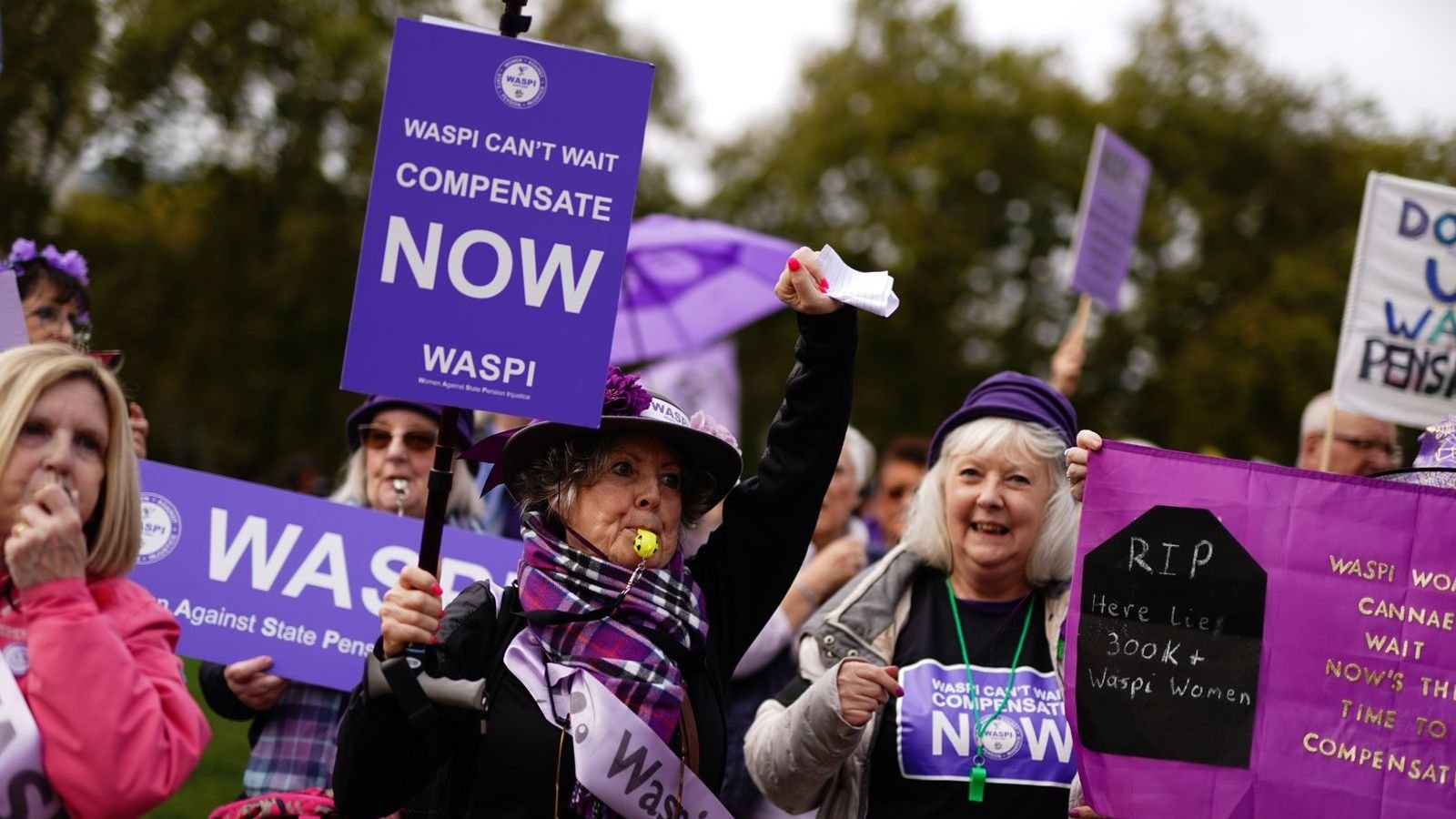
The government has reiterated its stance on rejecting the claims made by women in the Women Against State Pensions Inequality (Waspi) campaign, who argued that they were owed billions due to changes in their state pension age.
The campaign, which has been lobbying extensively, contended that women were not adequately informed about the increase in the state pension age from 60 to 65 to align with men.
Despite dismissing this claim in December 2024, the government announced a review in November of last year to consider new evidence.
The crux of the Waspi argument revolves around the assertion that the pension age change was implemented too swiftly, leaving many women financially unprepared for the years when they could not claim their state pension.
In 2024, the government stated that women would not be compensated as most were aware of the impending changes. However, they later initiated a review in late 2025 specifically addressing how the decision was communicated.
During a session in the House of Commons, Work and Pensions Secretary Pat McFadden reaffirmed the government’s decision on compensation and acknowledged the debate on the wisdom of accelerating the equalisation of pension ages to 66 in 2011.
McFadden clarified that the review focused on communication of the pension age changes rather than the policy decision-making process.
He admitted that the government could have sent out letters about the changes sooner and apologized for the delay.
Additionally, he concurred with the Parliamentary and Health Service ombudsman’s findings that the delay did not cause any direct financial harm to women.
Read more:
Workers being ‘hammered’ while pensioners benefit
Three major pension reforms happening in 2026
Campaigners considering legal action
Angela Madden, the chair of Waspi, criticized the government’s decision, stating, «This is a disgraceful political choice by a small group of very powerful people who have decided the harm and injustice suffered by millions of ordinary women simply does not matter.»
She added, «WASPI is taking legal advice, and all options remain on the table.» «We are prepared to explore all avenues in Parliament and in the courts to achieve the justice that has been unjustly withheld.»
Approximately 3.6 million women were impacted by the changes to the state pension age.
The government has estimated that compensating these women could cost £10.5 billion.
Women born between April 1951 and 1960 were affected by the changes.
The government has reiterated its stance on the Women Against State Pensions Inequality (Waspi) campaign, which has been advocating for compensation for women affected by changes to the state pension age. The campaign argues that women were not adequately informed about the changes that raised the pension age for women from 60 to 65, aligning it with that of men.
Despite initially rejecting the claim for compensation in December 2024, the government announced a review in November of the same year to consider new evidence presented by the campaign. The review specifically focused on how the decision to change the state pension age was communicated to the affected women.
In the House of Commons, Work and Pensions Secretary Pat McFadden reaffirmed the government’s decision not to compensate the women affected by the change in the pension age. He stated that the review had led to the same conclusion as the government’s previous stance in 2024. While acknowledging that there were concerns about the speed at which the changes were implemented, McFadden emphasized that the review was centered on the communication of the policy, not its decision-making process.
McFadden also acknowledged that there were delays in sending out individual letters about the changes to the state pension age, expressing apologies on behalf of the government for the oversight. However, he clarified that the delayed communication did not result in direct financial losses for the affected women, as determined by the Parliamentary and Health Service ombudsman.
The Waspi campaign has been advocating for around 3.6 million women born between April 1951 and 1960 who were impacted by the change in the state pension age. The government had estimated that compensating these women could cost £10.5 billion, but has not committed to providing compensation at this time.
The changes to the state pension age were initially announced in the 1995 Pensions Act, with a target to equalize male and female pensions by 2020. This deadline was later accelerated to 2018, with the pension age raised to 66 in 2011.
Despite the ongoing efforts of the Waspi campaign to seek justice and compensation for the affected women, the government has maintained its position on the matter, emphasizing the need for clarity and understanding in communicating such significant policy changes.
SOURCE

Por Michael Bunting
“I’m Michael Bunting, Communications Director with over 20 years of experience in corporate reputation, crisis management, and digital strategy. I have led teams in multinational companies and agencies, advised executives, and designed high-impact strategies. I am driven by transparency, innovation, and leveraging communication as a competitive advantage.”