

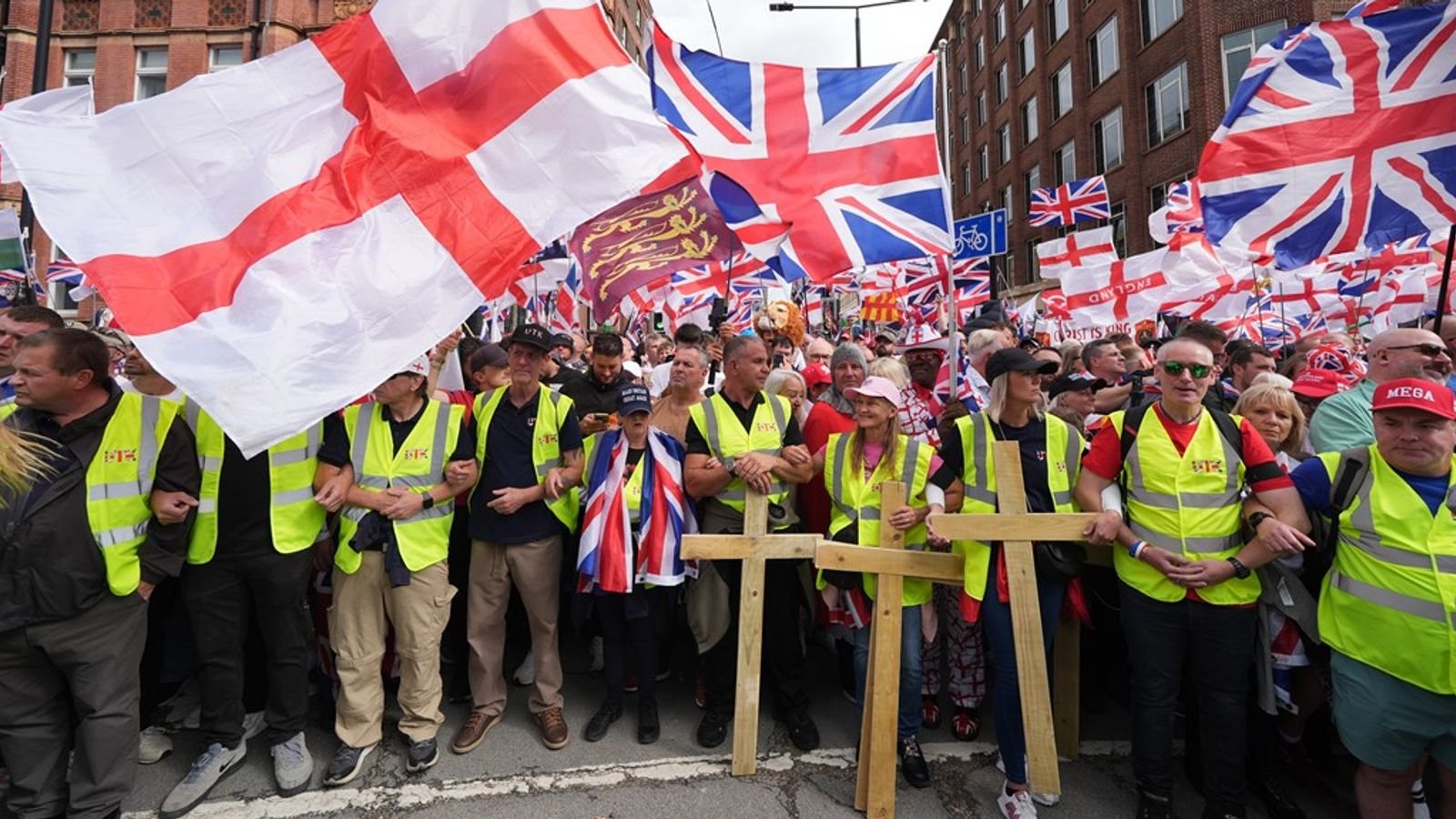
This was the largest nationalist gathering in recent memory, and perhaps in history.
Prior to the commencement of the march, a multitude of individuals traversed Blackfriars Bridge or arrived from Waterloo station, displaying flags from various regions – from Yorkshire roses to the diamond of the Isle of Wight.
The concept of what exactly «United the Kingdom» was intentionally left ambiguous, allowing attendees to vocally support their own specific causes.
Market as a rally for free speech, the prevalent chants included «Keir Starmer’s a w*****r», «oh Tommy Tommy», and «we want our country back».
These phrases carried different meanings for different participants.
As it unfolded: Thousands attend ‘Unite the Kingdom’ rally
Dawn, who traveled from Southampton and wore a red sequined jacket, expressed her concerns about the country being «overrun», specifically referring to illegal migration.
Others had broader concerns.
Danny from south Birmingham held a sign that read «Send them Back», expressing dissatisfaction with migration «in general». He attended to «defend what we believe in, the religion and identity of our country».
This rally differed from previous ones due to its overt Christian nationalism.
Many participants carried wooden crosses, with one individual even displaying a light-up crucifix.
Upon reaching Whitehall, the crowd engaged in a chant of ‘Christ is king’ followed by a public recital of the Lord’s Prayer. This marked a significant distinction, emphasizing not only a flag to unite under but also a shared religion.
At the forefront of the event was the anti-Islam activist Tommy Robinson.
When Robinson addressed the audience, the atmosphere resembled more of a sporting event or festival than a traditional political rally.
«We endured the challenges, we survived the challenges, and today we are the challenge,» he passionately exclaimed.
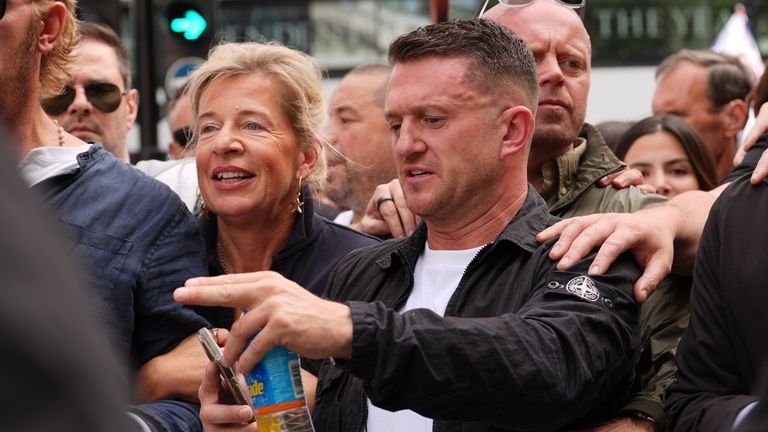
Katie Hopkins and Tommy Robinson take part in the «Unite the Kingdom» rally. Pic: PA
This sentiment was not an exaggeration, especially considering that Elon Musk, the wealthiest individual globally, made a virtual appearance to show his support for Robinson.
Among the speakers were individuals easily categorized as far-right, and violent clashes erupted between agitators and law enforcement.
It is evident that categorizing protesters simply as far-right does not fully encapsulate the diverse nature of the audience present. The spectrum of attendees is too broad to be confined to a single label.
While activists had predicted a volatile summer of protests, what transpired was a gradual intensification of nationalist sentiments rather than an explosive outburst.
This event marked the peak of this sentiment, with hopes from participants that it would pave the way for even greater movements in the future.