

Football and the royals are two subjects which have always attracted very outspoken fans. Now, aged 90, Lord Norman Foster is attempting to please both.
One of the one of the world’s most important living architects, he is known for being the vision behind some of the world’s most iconic designs – including London’s «Gherkin» building, the Millennium Bridge and the British Museum’s spectacular Great Court.
Arguably, however, two of his most talked about designs are yet to be built.
In June, his firm Foster + Partners was announced as having won the commission to build a national memorial in honour of the late Queen Elizabeth II.
Before that, in March, his firm’s vision for a new 100,000-seater stadium at Old Trafford was revealed, which he describes as «the project of a lifetime».

Pic: Foster + Partners/PA
‘A galvanising project’
«The fan base is incredible,» Lord Foster said of his excitement at being commissioned to work on the new ground.
For the renowned architect it is a homecoming of sorts, given Lord Foster’s working-class roots, having grown-up in Manchester.
Was he excited to be involved?
«You bet,» he exclaims.
«It’s a galvanising project… and so many things can naturally ride on the back of that sporting, emblematic kind of team.»
Set to cost around £2bn – with its three tall masts acting as a vast umbrella over Old Trafford – the design is part of a larger regeneration project which Lord Foster claims could be completed in five years.
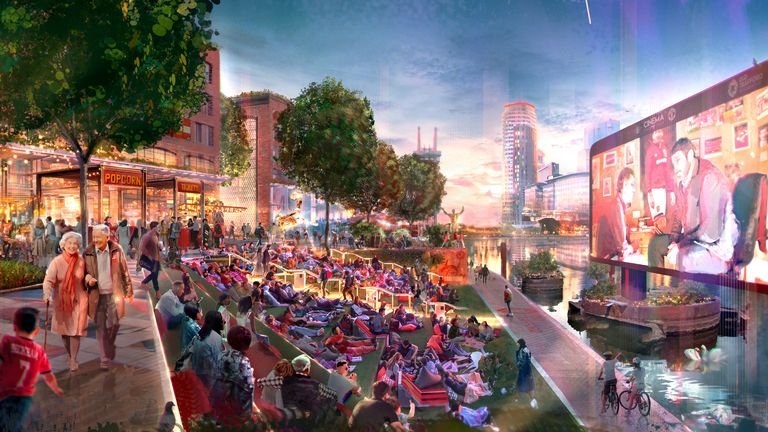
The stadium design is part of a larger regeneration project.
Pic: Foster + Partners/PA
It is described as a «master plan that will create streets, squares, neighbourhoods and connect with the heart of Manchester.»
Asked whether it will feel unlike any other British stadium, he said: «Manchester United is different and therefore its stadium’s going to be different… and better, of course.»
And what of the QEII memorial?
He says his design to remember the late monarch in London’s St James’ Park will be «more of all the good things».
His plans include a statue of Queen Elizabeth II standing next to her husband Prince Philip, and a semi-glass bridge which is a nod to her wedding tiara.

The royal gardens design. Pic: Foster+Partners and Malcolm Reading Consultants/PA
As for those who’ve questioned whether maintaining its sparkle might prove to be problematic, Lord Foster insists it’ll be «less maintenance, more joy».
He says his hope is «to address the many millions who traverse that [park], the daily commuters and many tourists, and to make that more human, to make it a better experience and a reminder of the legacy of the most extraordinary long-serving monarch».
After collecting the London Design Festival’s prestigious lifetime achievement medal earlier this week, with six decades of experience under his belt, Lord Foster says he finds Britain’s inability to invest in infrastructure frustrating.
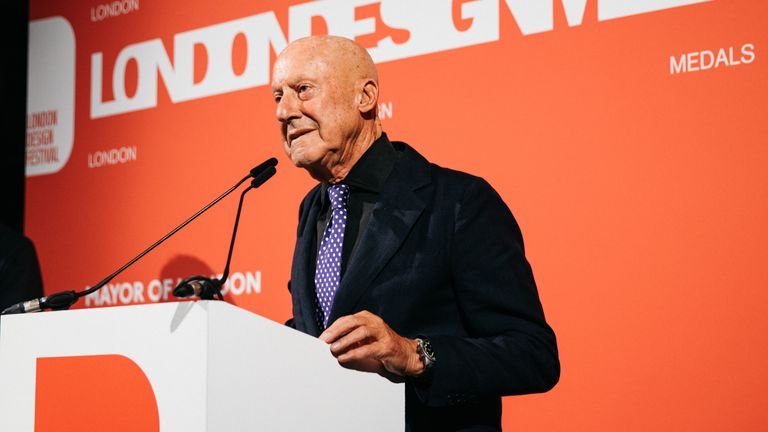
Lord Foster speaks at the awards ceremony
«I lamented, like so many, the cancellation of HS2,» he says. The long-delayed rail route’s northern leg to Manchester was scrapped by Rishi Sunak in 2023.
«That was about levelling-up.»
Lord Norman Foster, one of the world’s most important living architects at 90 years old, is working on projects that aim to please both football and royal fans.
His firm, Foster + Partners, recently won the commission to build a national memorial in honor of Queen Elizabeth II, and they also revealed plans for a new 100,000-seater stadium at Old Trafford.
Lord Foster believes that «connectivity is the answer to many social issues» and emphasizes the importance of design and planning for the future of cities.
He expresses his excitement about the projects, describing the stadium as a «galvanising project» that could lead to further regeneration in the area.
The stadium design is part of a larger plan to create streets, squares, and neighborhoods that connect with the heart of Manchester.
Regarding the QEII memorial, Lord Foster promises a design that embodies «all the good things» and includes a statue of Queen Elizabeth II and Prince Philip, as well as a semi-glass bridge inspired by her wedding tiara.
Pic: Foster + Partners and Malcolm Reading Consultants/PA
Lord Norman Foster, a renowned architect at 90 years old, is embarking on projects that aim to please football and royal enthusiasts alike. With a legacy of designing iconic structures like London’s «Gherkin» building and the Millennium Bridge, Lord Foster’s latest endeavors have sparked conversations worldwide.
His firm, Foster + Partners, recently secured the commission to construct a national memorial in remembrance of Queen Elizabeth II. Additionally, their proposal for a new 100,000-seater stadium at Old Trafford has generated significant interest, described by Lord Foster as «the project of a lifetime».
Addressing concerns about the maintenance of these new structures, Lord Foster remains optimistic, emphasizing that they will bring more joy than maintenance hassles. He envisions enhancing the experience for millions of visitors, commuters, and tourists, aiming to humanize public spaces and honor the legacy of Queen Elizabeth II.
Reflecting on his decades-long career and the state of infrastructure investment in the UK, Lord Foster expresses frustration over the cancellation of projects like HS2’s northern leg to Manchester. He believes that such initiatives are crucial for regional development and improving connectivity, which in turn addresses social issues and benefits local communities.
In a society where short-term priorities often overshadow long-term planning, Lord Foster stresses the importance of political awareness in design and urban planning. He emphasizes the dynamic nature of cities, highlighting the need for proactive planning and adaptation to change for successful urban development.
As a recipient of the London Design Festival’s lifetime achievement award, Lord Foster’s insights shed light on the critical role of design in shaping cities and communities. His vision for a more sustainable and connected urban landscape underscores the need for strategic investment and long-term planning to create vibrant and resilient cities.
With projects that blend architectural innovation with social impact, Lord Norman Foster continues to push boundaries and redefine the built environment for future generations. His contributions to the architectural landscape are a testament to his enduring legacy and commitment to creating spaces that inspire and enrich the lives of all who inhabit them. Pic: Foster + Partners/PA
SOURCE

Por Michael Bunting
“I’m Michael Bunting, Communications Director with over 20 years of experience in corporate reputation, crisis management, and digital strategy. I have led teams in multinational companies and agencies, advised executives, and designed high-impact strategies. I am driven by transparency, innovation, and leveraging communication as a competitive advantage.”