
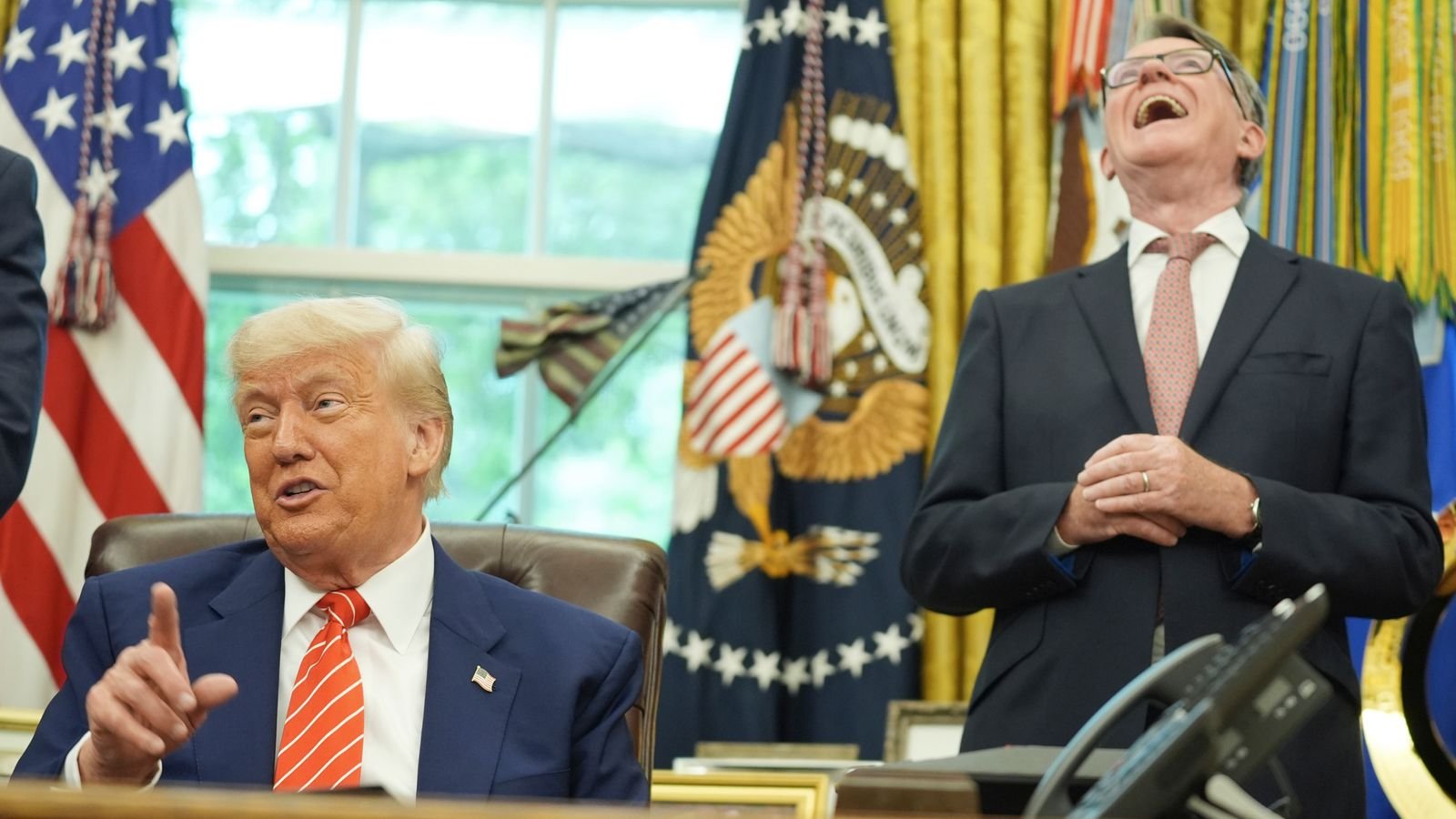
The UK and US have hailed a «fantastic, historic day» after striking a landmark trade deal. In President Donald Trump’s own words, this has been years in the making «but it got there with this prime minister.» But while Sir Keir Starmer will be no doubt celebrating, the devil is in the detail. Politics latest: Trump says UK-US trade deal is ‘great honour’.
Here, Sky News looks at what has been announced. Not a full trade deal The first thing to note is that this isn’t a free trade deal in the conventional sense, but one that focuses on specific sectors – notably cars, steel, and agriculture. It has led to the reduction in some, but not all, of the tariffs Mr. Trump imposed on the UK as part of a sweeping package of global measures last month. This included a 10% levy on all UK exports and a higher charge on steel, aluminum, and cars. And, importantly, the published terms note: «Both the United States and the United Kingdom recognize that this document does not constitute a legally binding agreement.»
Tariff exemptions on cars and steel As a result of Thursday’s deal, car export tariffs will be reduced from 27.5% to 10%, to match Mr. Trump’s baseline levy. The lower car rate applies to the first 100,000 vehicles exported from the UK to the US each year, which Downing Street said is almost the total the UK exported last year. British carmakers were intensely worried about the impact of tariffs on their industry, so it is hoped the reduction will save thousands of jobs. Separately, the UK steel industry – on the brink of collapse just a few weeks ago – now won’t face high tariffs after the US agreed to scrap the 25% rate for the UK. The agreement says: «The US will promptly construct a quota at most favored nation (MFN) rates for UK steel and aluminum and certain derivative steel and aluminum products.» A 10% levy remains on all other goods coming to the US from the UK, which will be the focus of the next stage of discussions, it is understood. At respective news conferences on Thursday, Sir Keir said the deal has resulted in «jobs saved, jobs won but not job done», while Mr. Trump said the deal was «comprehensive» but he’d like to see it «go further». The prime minister said the new measures will save thousands of jobs in the car and steel industries, which were threatened by Mr. Trump’s tariffs.
New deal on beef – but no drop in standards The UK has had to make concessions on agriculture in exchange for the tariff exemptions, with the deal including new reciprocal market access to beef. This means US farmers will have access to the UK for the first time, and UK farmers will have access to the US, at a tariff-free quota of 13,000 metric tonnes. Business Secretary Jonathan Reynolds said this is a fraction of the 35,000 tonnes agreed as part of the Tories’ trade deal with Australia, which rises to 110,000 metric tonnes over time and which farmers said undercut them. Crucially, the US deal has not involved a weakening of UK food standards on imports, which has previously been a red line in negotiations. That means hormone-injected beef (and chlorinated chicken) still won’t be allowed on UK shelves, a move that has been welcomed by farming groups.
Ethanol The UK has also agreed to remove the tariff on ethanol – which is used to produce beer – coming into the UK from the US, down to zero. «The United Kingdom will offer a preferential duty-free tariff rate quota of 1.4 billion liters for US ethanol,» the agreement explains. US commerce secretary Howard Lutnick said that together with the beef deal, this would create five billion dollars in «opportunity for American exports».
Aerospace Mr. Lutnick also said the US has agreed to drop tariffs on Rolls-Royce engines and other plane parts from the UK. It was confirmed on Friday that British Airways’ parent company has bought 32 new Boeing planes from the US, following the country’s trade agreement with the UK on Thursday. International Airlines Group (IAG) confirmed the order of the Boeing 787-10 aircraft for its BA fleet, alongside 21 Airbus planes for its other airlines. IAG did not confirm how much it had paid for the planes in its announcement.
👉 Follow Trump100 on your podcast app 👈
What wasn’t in the deal? Health Secretary Wes Streeting told Sky News in February that while the NHS is «not up for grabs», NHS patients could take part in US clinical trials as part of a deal in life sciences and medical research. He also told BBC Radio Four that in return for being in the «driving seat for that groundbreaking research», we should expect British patients «are at the front of the queue for those new treatments and technologies». There was no mention of this in Thursday’s announcement. However, Sir Keir said that as part of the deal, the UK has secured «preferential treatment whatever happens in the future» when it comes to pharmaceuticals, as Mr. Trump considers import taxes on drugs and medicines. Read More: Starmer’s gamble on Trump appears to have paid off Film tariffs Mr. Trump has also touted the possibility of film tariffs, though like pharmaceuticals, no details have been announced. Sir Keir said film tariffs weren’t included in Thursday’s deal as they aren’t currently in place but «of course we’re discussing it with the president’s team».
Tech Previous speculation had suggested the UK would revise the digital services tax as part of a deal, with the levy mainly applying to US tech companies. However, this remains unchanged. Instead, the two sides have agreed
SOURCE