Producer Giles Martin has likened plans to allow AI firms to use artists’ work without permission, unless creators opt out, to giving criminals free rein to burgle houses unless specifically told not to do so.
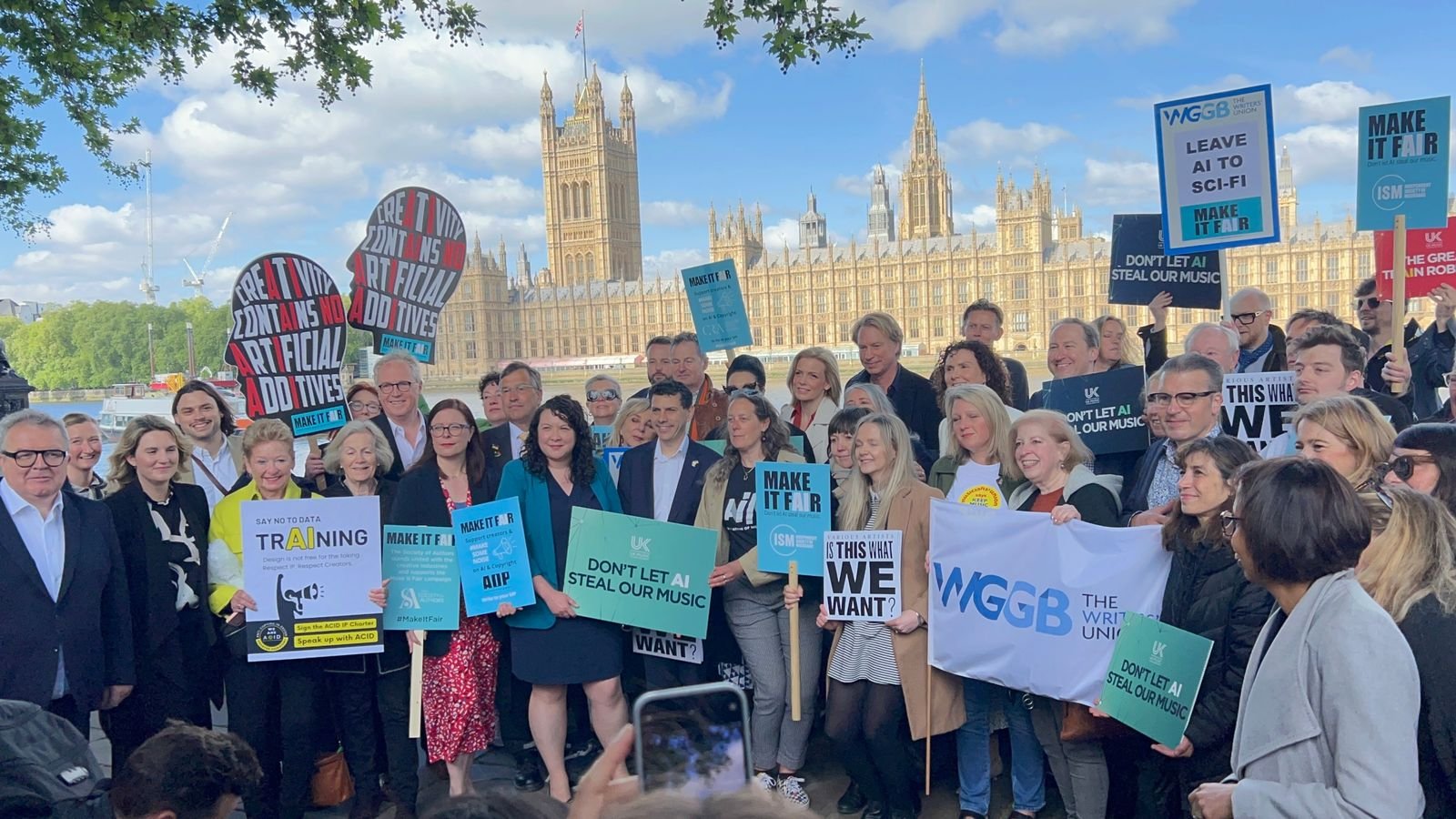
Martin, the son of Beatles producer George Martin and collaborator with Sir Paul McCartney on projects like the Get Back documentary series and the 2023 Beatles track Now And Then, voiced his concerns to Sky News at a UK Music protest at Westminster during a parliamentary debate on the issue.
These plans propose creating an exemption to copyright for training artificial intelligence (AI), allowing tech firms to use copyrighted material without a license unless creators choose to opt out.
Creatives argue that it should be opt-in rather than opt-out, urging the government to abandon the proposals and prevent AI developers from «stealing» their work «without payment or permission.»
«If you create something unique it should be unique to you,» Martin stated. «It shouldn’t be able to be harvested and then used by other people. Or if it is, it should be with your permission… it shouldn’t be up to governments or big tech.»
Sir Elton John and Simon Cowell have joined the campaign against these proposals, with Sir Paul McCartney also expressing his opposition.
«This is about young artists,» Martin emphasized. «If a young Paul McCartney at the age of 20 or 22 wrote Yesterday, now… big tech would almost be able to harvest that song and use it for their own means. It doesn’t make any sense, this ruling of opting out – where essentially it’s like saying, ‘you can burgle my house unless I ask you not to’.»
‘I’m not anti-AI – it’s a question of permission’
The Beatles’ track Now And Then was written and recorded by John Lennon in New York in the late 1970s, and AI was used to extract his vocals for the 2023 release. The Get Back documentary also utilized audio restoration technology to isolate music and vocals.
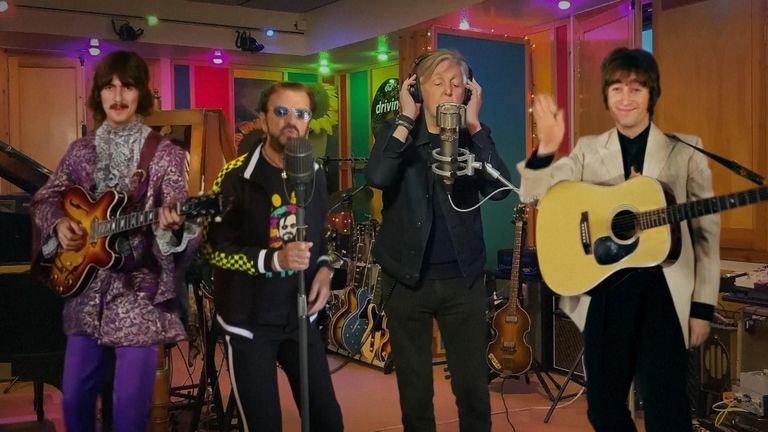
AI was used to release The Beatles’ track Now And Then in 2023. Pic: Apple Corps Ltd
«I’m not anti [AI], I’m not saying we should go back to writing on scribes,» Martin noted. «But I do think that it’s a question of artist’s permission.»
The use of AI to «excavate» Lennon’s voice was done with the permission of the late singer’s estate, distinguishing it from creating a replica of John Lennon with a 3D printer.
He added: «The idea of, for example, whoever your favorite artist is – the future is, you get home from work and they’ll sing you a song, especially designed for you, by that artist, by that voice. And it’ll make you feel better because AI will know how you’re feeling at that time. That’s maybe a reality. Whoever that artist is, they should probably have a say in that voice.»
Read more:
Authors ‘absolutely sick’ to discover books in ‘shadow library’
AI tool could be game-changer in battle against Alzheimer’s
Crispin Hunt, from the 1990s band The Longpigs, who also participated in the protest, emphasized the importance of oversight for all technology.
«If you remove the ability for the world to make a living out of creativity, or if you devalue creativity to such an extent that it becomes a hobby and worthless to do, then humanity in life will be far less rich because it’s art and culture that makes life richer,» he stated.
«And that’s why the companies want it for free.»
The Data (Use and Access) Bill primarily covers data-sharing agreements, but transparency safeguards were removed at committee stage.
Critics say changes need to be made to ensure that companies training generative AI models disclose whether work by a human creator has been used and protect creatives under existing copyright rules.
In February, more than 1,000 artists and musicians including Kate Bush, Damon Albarn, Sam Fender, and Annie Lennox released a silent album in protest at the proposed changes.
At that time, a government spokesperson said the UK’s current rules were «holding back the creative industries, media and AI sector from realizing their full potential – and that cannot continue».
The spokesperson said they were consulting on proposals that better protect the «interests of both AI developers and right holders» and to deliver a solution «which allows both to thrive».
Producer Giles Martin has said plans to allow AI firms to use artists’ work without permission, unless creators opt out, is like criminals being given free rein to burgle houses unless they are specifically told not to.
Martin, who is the son of Beatles producer George Martin and worked with Sir Paul McCartney on the Get Back documentary series and the 2023 Beatles track Now And Then, spoke to Sky News at a UK Music protest at Westminster coinciding with a parliamentary debate on the issue.
Under the plans, an exemption to copyright would be created for training artificial intelligence (AI), so tech firms would not need a license to use copyrighted material – rather, creators would need to opt out to prevent their work from being used.
Creatives say if anything it should be opt-in rather than out, and are calling on the government to scrap the proposals and stop AI developers «stealing» their work «without payment or permission».
«If you create something unique it should be unique to you,» says Martin. «It shouldn’t be able to be harvested and then used by other people. Or if it is, it should be with your permission… it shouldn’t be up to governments or big tech.»
Sir Elton John and Simon Cowell are among the celebrities who have backed a campaign opposing the proposals, and Sir Paul has also spoken out against them.
«This is about young artists,» says Martin. «If a young Paul McCartney at the age of 20 or 22 wrote Yesterday, now… big tech would almost be able to harvest that song and use it for their own means. It doesn’t make any sense, this ruling of opting out – where essentially it’s like saying, ‘you can burgle my house unless I ask you not to’.»
‘I’m not anti-AI – it’s a question of permission’
The Beatles’ track Now And Then was written and recorded by John Lennon in New York in the late 1970s, and AI was used to extract his vocals for the 2023 release. The Get Back documentary also used audio restoration technology, allowing music and vocals to be isolated.
«I’m not anti [AI], I’m not saying we should go back to writing on scribes,» Martin said. «But I do think that it’s a question of artist’s permission.»
Using AI to «excavate» Lennon’s voice was with the permission of the late singer’s estate, he said, and is «different from me getting a 3D printer to make a John Lennon».
He added: «The idea of, for example, whoever your favorite artist is – the future is, you get home from work and they’ll sing you a song, especially designed for you, by that artist, by that voice. And it’ll make you feel better because AI will know how you’re feeling at that time. That’s maybe a reality. Producer Giles Martin has likened the plans to allow AI firms to utilize artists’ work without permission, unless creators opt out, to giving criminals free rein to burglarize houses unless explicitly told not to. Martin, known for his work with Sir Paul McCartney on the Get Back documentary series and the 2023 Beatles track Now And Then, expressed his concerns at a UK Music protest at Westminster during a parliamentary debate on the issue.
The proposed plans involve creating an exemption to copyright for training artificial intelligence (AI), meaning tech firms would not require a license to use copyrighted material – instead, creators would need to actively opt out to prevent their work from being utilized. Creators argue that it should be opt-in rather than opt-out and are urging the government to abandon the proposals to prevent AI developers from «stealing» their work without permission or compensation.
Martin emphasized the importance of uniqueness and ownership over one’s creative work, stating that anything one creates should be uniquely theirs and not subject to being used by others without their consent. He criticized the notion that governments or big tech companies should have the authority to decide how creators’ work is used.
Celebrities such as Sir Elton John and Simon Cowell have joined the campaign against the proposals, with Sir Paul McCartney also voicing his opposition. Martin highlighted the implications for young artists, suggesting that under the proposed rules, iconic songs like «Yesterday» by a young Paul McCartney could be harvested by big tech companies for their own purposes.
The Beatles’ track «Now And Then,» originally written and recorded by John Lennon in the late 1970s, saw AI being used to extract his vocals for the 2023 release. The Get Back documentary also utilized audio restoration technology to isolate music and vocals.
Martin clarified that his concerns were not anti-AI but rather centered around the importance of permission when it comes to utilizing creative works. He emphasized the need to protect artists’ rights and ensure that their work is not exploited without their knowledge or consent. However, I do believe that it ultimately comes down to the artist’s permission. Using AI to recreate Lennon’s voice was done with the approval of his estate, which is different from simply replicating him with a 3D printer. The future possibility of having AI generate personalized songs from your favorite artist’s voice raises questions about the artist’s consent in such a scenario.
Crispin Hunt, a member of the 1990s band The Longpigs who was also present at the protest, emphasized the importance of oversight in all technological advancements. He highlighted the significance of valuing creativity and ensuring that artists can make a living from their work, as art and culture enrich human life.
The Data (Use and Access) Bill primarily focuses on data-sharing agreements, but concerns have been raised about the lack of transparency safeguards. Critics argue that changes are needed to ensure that companies disclose the use of human creators’ work in training generative AI models and uphold existing copyright laws to protect creatives.
In response to the proposed changes, over 1,000 artists and musicians, including Kate Bush, Damon Albarn, Sam Fender, and Annie Lennox, released a silent album as a form of protest. The UK government spokesperson acknowledged the need to balance the interests of AI developers and right holders to support the growth of the creative industries, media, and AI sector. They are consulting on proposals to find a solution that allows both parties to thrive.
SOURCE

Por Michael Bunting
“I’m Michael Bunting, Communications Director with over 20 years of experience in corporate reputation, crisis management, and digital strategy. I have led teams in multinational companies and agencies, advised executives, and designed high-impact strategies. I am driven by transparency, innovation, and leveraging communication as a competitive advantage.”