


Resting on young shoulders, a white coffin is carried through a youth centre in southeast London.
The scene looks like a funeral. That is the intention – but it is something else entirely.
Inside the coffin is a large sculpture: a bloodied knife carved with the skyline of London. The imagery is stark.

The central piece of the installation
A group gathers around the coffin to take it in. Some of them are in tears.
It forms part of a new anti-knife crime project titled Re-claim, created by multimedia artist Eugene Ankomah and designed to shine a light on teenagers «lost to the streets».
Mr Ankomah says the reaction from some visitors has been emotional.

Eugene Ankomah believes his artwork can help play a part in reducing knife crime
«I have had young people who have carried knives in the past come into this venue, and some of them have broken down crying,» he said.
«That’s what I want. I want them to have a change of heart, a change of mind.»
The installation, based at the Salmon Youth Centre in Bermondsey, takes visitors along what Mr Ankomah describes as an «incident trail», guiding them through a simulated crime scene.
One young person, dressed in a forensic suit, explains: «The idea is for visitors to experience what a crime scene feels like.»
Mr Ankomah recognises parts of the project may be difficult for some people, but says «this installation is consciously confrontational».
«This is a fight, and we have to keep fighting in every possible way,» he said.
«The more innovative it is, I think the better.»

Michael Jibowu was jailed for stabbing a teenager
The campaigner who was jailed for knife attack
Inside the main installation room we meet Michael Jibowu, who once carried a knife himself.
In 2022, he was jailed for stabbing a teenager three times in the neck. His victim survived.
Four years on, Mr Jibowu now campaigns to raise awareness about knife crime.
The 24-year-old said he has a direct message for those who carry knives.
«Every single person I know that’s carried a knife, they’ve either ended up dead or in a prison cell. Take it from me, I’ve gone to prison for stabbing someone.
«You don’t have to listen to me, but the choice is yours. If you want to carry a knife, be ready for the consequences. I’m not saying it to scare you, I’m saying [the] reality.»

In one room are photographs, messages and teddy bears, echoing the makeshift memorials often left at murder scenes
The latest figures show knife crime has fallen over the past year, dropping below pre-pandemic levels, but offences are still more than 50% higher than a decade ago.
The government has committed to halving knife crime within a decade as part of its Plan for Change strategy.
But Mr Jibowu believes statistics alone cannot explain the issue.
«Data helps,» he said. «But we need to understand the individual, why they are carrying knives. The primary question we must consider is «why?»
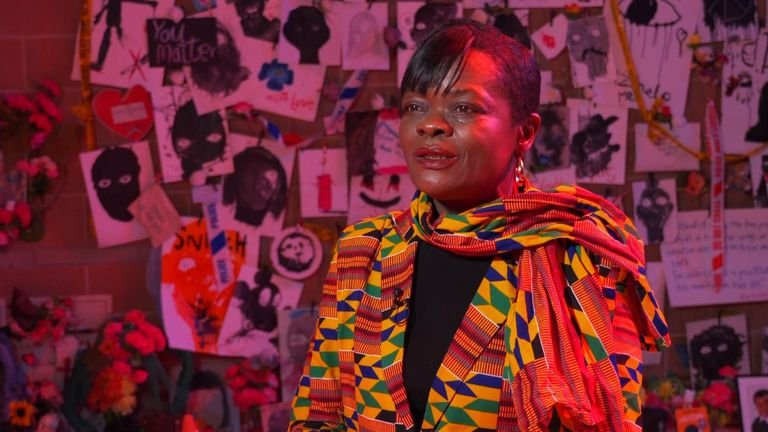
Sylvia Kane describes her son’s passing as a ‘life imprisonment’
Helping heal knife victim’s mother
This is the question Sylvia Kane has been grappling with for twenty years.
Her son, Eugene, was fatally stabbed at the age of 16 in Mitcham, south London, in 2006.

A photo of Sylvia’s son, Eugene, is displayed at the installation
Kane acknowledges that engaging with projects like this is painful, but also a part of her healing process.
«I believe artwork like that created by Eugene Ankomah has the potential to combat knife crime because of its profound impact,» she expressed.
«It is visually striking and evokes emotions in a way that other initiatives might not.»
While the influence of such initiatives on behavior is challenging to quantify, they do provide opportunities for contemplation, community engagement, and dialogue – and perhaps, for some individuals, a chance to opt for a different path.
The purpose of this installation at the Salmon Youth Centre in Bermondsey is to evoke a change of heart and mind in visitors. The installation, created by Eugene Ankomah, leads visitors through an «incident trail» that simulates a crime scene. The goal is for visitors to experience the emotions and gravity of being in a crime scene firsthand.
One of the young participants, dressed in a forensic suit, explains that the installation aims to give visitors a sense of what a crime scene feels like. Ankomah acknowledges that some parts of the project may be challenging for people, but he emphasizes that the installation is intentionally provocative and confrontational. He believes that in the fight against crime, innovative approaches like this installation are crucial.
The main installation room features Michael Jibowu, a former knife carrier who was incarcerated for stabbing a teenager. Now, Jibowu advocates for raising awareness about knife crime. He has a direct message for those who carry knives, warning them about the potential consequences of their actions. Jibowu’s firsthand experience serves as a powerful reminder of the real-life impact of knife violence.
The installation also includes a room with photographs, messages, and teddy bears, reminiscent of makeshift memorials left at murder scenes. These visuals aim to evoke emotional responses and prompt reflection on the devastating consequences of knife crime.
Despite a decrease in knife crime over the past year, the issue remains a significant concern, with offenses still higher than a decade ago. The government has pledged to reduce knife crime by half within the next decade as part of its Plan for Change strategy. However, Jibowu stresses that understanding the underlying reasons why individuals carry knives is essential in addressing the root causes of the problem.
Sylvia Kane, whose son Eugene was fatally stabbed in 2006, has been grappling with the question of why knife crime persists for over two decades. Engaging with projects like Ankomah’s installation is part of Kane’s healing process. She believes that powerful artwork like this has the potential to prevent knife crime by resonating with people emotionally.
While it may be challenging to measure the direct impact of initiatives like Ankomah’s installation on behavior change, they provide spaces for reflection, community engagement, and dialogue. These initiatives offer individuals the opportunity to reconsider their choices and potentially choose a different path away from violence.
The installation at the Salmon Youth Centre serves as a powerful reminder of the human cost of knife crime and encourages visitors to confront the harsh realities of violence. Through innovative and thought-provoking approaches, Ankomah and his team strive to inspire positive change and foster a safer community for all. The images are striking, showcasing a carefully constructed act confronting the issue of knife crime. One image features the central piece of the installation, while another shows the artist’s belief in using art to combat knife crime. Visitors to the installation, located at the Salmon Youth Centre in Bermondsey, are led through a simulated crime scene, aiming to evoke real emotions. The project, designed by multimedia artist Eugene Ankomah, is deliberately confrontational, with the goal of prompting a change of heart and mind in those who have carried knives. The installation also features a room with photographs, messages, and teddy bears reminiscent of makeshift memorials left at murder scenes. Despite a decrease in knife crime over the past year, the issue remains prevalent, and efforts to understand the root causes are crucial according to campaigner Michael Jibowu. The crucial question we must ask ourselves is «why?»
SOURCE