
The average person now has £38 less to spend each month after tax than they did at the end of 2024, following three consecutive quarters of falling UK living standards.
The government made «improving living standards across all every part of the UK» one of their most high profile targets to achieve before the next election.
The previous parliament, between December 2019 and July 2024, was the first in recorded British history to oversee a fall in disposable income in real terms.
But disposable income is now £1 lower per month than it was in summer 2019 after adjusting for inflation, according to Monday’s updated figures from the Office for National Statistics, and more than £20 lower than in December 2019.
Disposable income is the money people have left over after paying taxes and receiving benefits (including pensions).
Essential expenses like rent or mortgage payments, council tax, food and energy bills all need to be paid from disposable income.
Before 2022 there had been only one five-year period where living standards fell. That was between 2008 and 2013, following the financial crisis and austerity policies that followed.
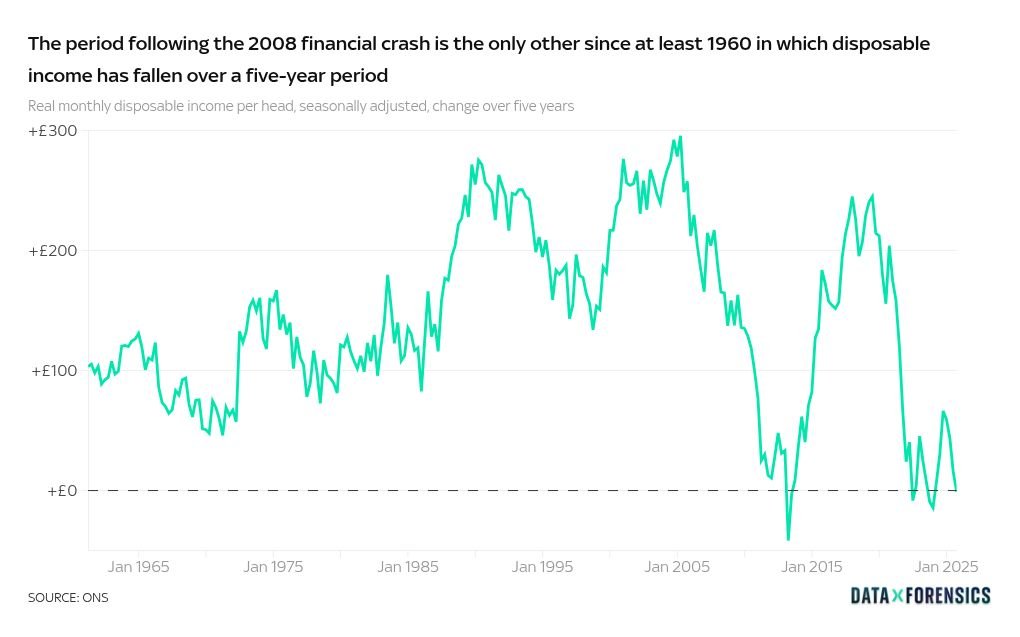
There have been just five other occasions since the 1950s where disposable income fell for three consecutive quarters. Three of those were in the 2010s, with the others during the early 1960s and late 1970s.
The longest sustained fall was five consecutive quarters between December 2015 and March 2017, coinciding with the UK voting to leave the EU.
Simon Pittaway, Senior Economist at living standards think tank the Resolution Foundation, told Sky News:
«Today’s ONS data confirms that Britain’s mini living standards bounce in 2024 is well and truly over. Growth has been poor this year and prospects for 2026 aren’t looking great either.
«Stepping back, Britain’s big problem is that the country experienced three once-in-a-generation economic shocks in less than two decades [the 2008 financial crash, Brexit, and the cost of living crisis/COVID], with people in their mid-late 30s having spent their entire working lives lurching from one national crisis to another.
«We need to avoid further shocks so that we can focus instead on boosting economic growth and lifting living standards.»
Sky News has been tracking the government’s performance against some of their key economic targets, including living standards, inflation and growth.
Despite the now three quarters of decline, living standards are up overall since Labour took office, after rapid growth in their first six months continued the trend of the final few months of the outgoing government.
Inflation has risen however, and Britain is now the fourth-fastest growing G7 country behind the US, Japan and Canada. Use our tool to explore the country’s performance on other important metrics:
Responding to today’s figures, a spokesperson for the prime minister told reporters:
«Living standards dropped last parliament, but we’re working to improve them. Real wages have risen more in the last year than in the first 10 years of the previous government. This budget included help with energy bills, prescription fees, fuel duty and rail fares. It’s expected to help lower inflation next year, inflation fell to 3.2% in November.
«Lower interest rates, six of them so far since the election, will help people and businesses borrow and spend. And we’ve also raised the national living wage, giving full-time low earners £900 more a year, and those on the national minimum wage at £1,500 more a year.
«We are, of course, always seeking to do more on growth, the economy has grown faster than expected this year, and most forecasts have been upgraded.»
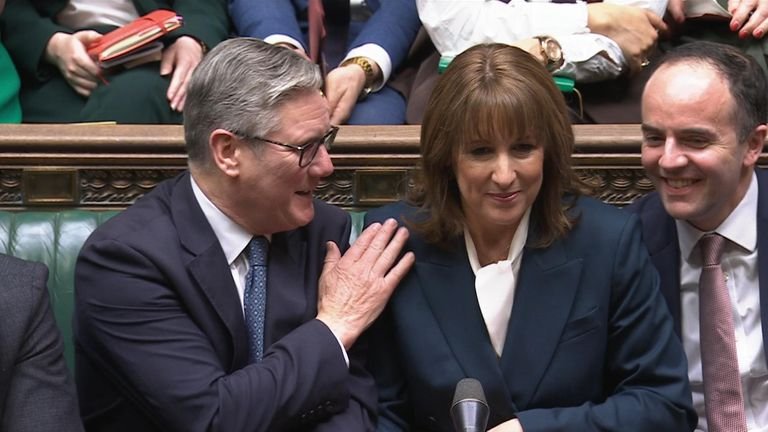
Rachel Reeves delivered her second budget in November, including a promise to end the two-child benefit cap and an extension to the tax threshold freeze
Following the budget in November, anti-poverty think tank the Joseph Rowntree Foundation projected that living standards would fall by £850 a year over the course of this parliament.
They also said that some actions at the budget, for example lifting the two-child benefit cap, would make the decline in living standards «less painful» for low-income households.
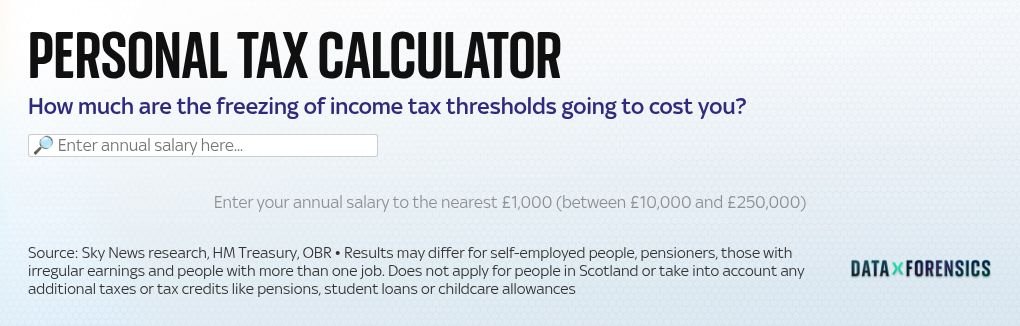
Frozen tax thresholds mean that many people will be paying thousands of pounds a year more tax in real terms by the end of this parliament than they do currently, however, including low earners.
Read more:
Budget tax threshold freeze: Use our calculator to see how much more you will pay
Sky News has also been tracking Labour’s performance against their key policy targets, like small boat Channel crossings, housebuilding and renewable energy.
Explore their performance towards those below:
Click here to read more information about why we picked these targets and how we’re measuring them.
The Data and Forensics team is a multi-skilled unit dedicated to providing transparent journalism from Sky News. We gather, analyse and visualise data to tell data-driven stories. We combine traditional reporting skills with advanced analysis of satellite images, social media and other open source information.
Through multimedia storytelling we aim to better explain the world while also showing how our journalism is done.
The national living wage has been raised, resulting in full-time low earners receiving £900 more a year, while those on the national minimum wage will get £1,500 more annually. The economy has grown faster than expected this year, with most forecasts being upgraded.
After the budget in November, the Joseph Rowntree Foundation projected that living standards would fall by £850 a year over the course of this parliament. However, some measures announced in the budget, such as lifting the two-child benefit cap, would help alleviate the decline in living standards for low-income households. Despite these efforts, frozen tax thresholds mean that many individuals, including low earners, will end up paying thousands more in taxes by the end of this parliament.
The average person now has £38 less to spend each month after tax compared to the end of 2024, following three consecutive quarters of declining UK living standards. The government has made improving living standards a key target before the next election. Disposable income, which is the money people have left after taxes and benefits, has seen a decline, with essential expenses becoming harder to afford.
Before 2022, there was only one five-year period where living standards fell, between 2008 and 2013. Since the 1950s, there have been only five other instances where disposable income fell for three consecutive quarters. The Resolution Foundation has highlighted the challenges facing Britain, with multiple economic shocks in a short period affecting living standards.
Despite the recent decline, living standards have seen an overall increase since Labour took office, with inflation rising and the UK being the fourth-fastest growing G7 country. Sky News has been monitoring the government’s performance on economic targets such as living standards, inflation, and growth.
To continue addressing economic challenges, the focus should be on avoiding further shocks and boosting economic growth to lift living standards for all individuals. Use our tool to explore the country’s performance on other important metrics:
Responding to today’s figures, a spokesperson for the prime minister told reporters:
«Living standards dropped last parliament, but we’re working to improve them. Real wages have risen more in the last year than in the first 10 years of the previous government. This budget included help with energy bills, prescription fees, fuel duty and rail fares. It’s expected to help lower inflation next year, inflation fell to 3.2% in November.
Lower interest rates, six of them so far since the election, will help people and businesses borrow and spend. And we’ve also raised the national living wage, giving full-time low earners £900 more a year, and those on the national minimum wage at £1,500 more a year.
We are, of course, always seeking to do more on growth, the economy has grown faster than expected this year, and most forecasts have been upgraded.»
Following the budget in November, anti-poverty think tank the Joseph Rowntree Foundation projected that living standards would fall by £850 a year over the course of this parliament. They also said that some actions at the budget, for example lifting the two-child benefit cap, would make the decline in living standards «less painful» for low-income households. Frozen tax thresholds mean that many people will be paying thousands of pounds a year more tax in real terms by the end of this parliament than they do currently, however, including low earners.
Read more:
Budget tax threshold freeze: Use our calculator to see how much more you will pay
Sky News has also been tracking Labour’s performance against their key policy targets, like small boat Channel crossings, housebuilding and renewable energy. Explore their performance towards those below:
Click here to read more information about why we picked these targets and how we’re measuring them.
The Data and Forensics team is a multi-skilled unit dedicated to providing transparent journalism from Sky News. We gather, analyse and visualise data to tell data-driven stories. We combine traditional reporting skills with advanced analysis of satellite images, social media and other open source information. Through multimedia storytelling we aim to better explain the world while also showing how our journalism is done.
SOURCE

Por Michael Bunting
“I’m Michael Bunting, Communications Director with over 20 years of experience in corporate reputation, crisis management, and digital strategy. I have led teams in multinational companies and agencies, advised executives, and designed high-impact strategies. I am driven by transparency, innovation, and leveraging communication as a competitive advantage.”