

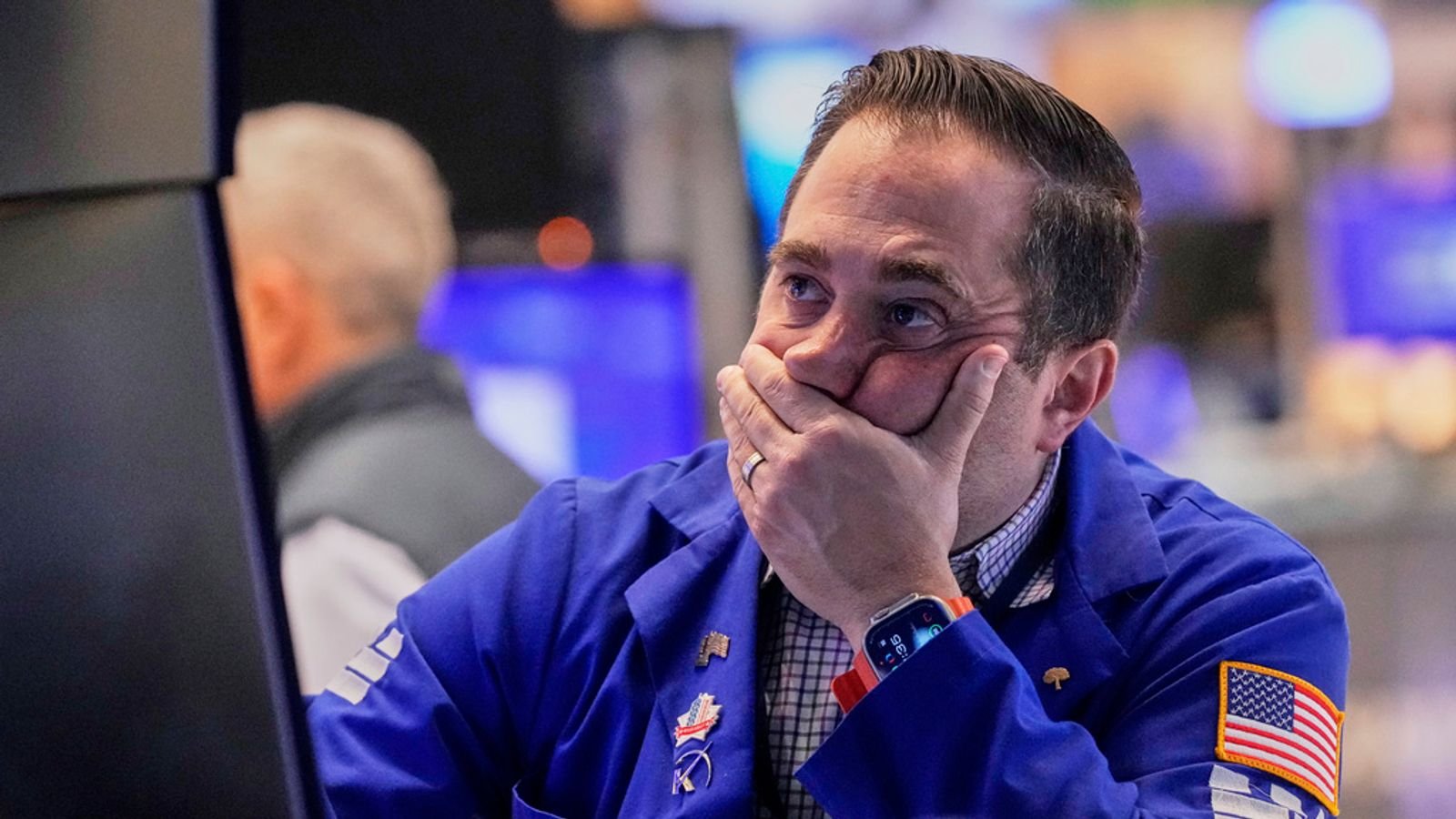
US stock markets experienced significant losses on Wednesday, primarily due to leading AI chipmakers facing challenges with new export restrictions to China, resulting in potential losses amounting to billions of dollars. Nvidia witnessed a decline of 6.87%, with a momentary drop of 10%, as the company disclosed the necessity of obtaining a US government license to sell its H20 chip. AMD, a competitor in the chipmaking industry, also faced a setback with a 7.35% slump after anticipating an $800m (£604m) charge due to the licensing requirement for its MI308 chip. ASML, a Dutch company essential in chip manufacturing hardware, saw a decrease of over 5% following a shortfall in order expectations and citing US tariffs as a source of uncertainty. These losses reverberated across the tech-heavy Nasdaq index, which managed to recover slightly to conclude 3% lower, while the broader S&P 500 index fell by 2.2%.
The situation would have been dire if not for recent disruptions in the market. The focus remains on China in light of President Donald Trump’s tariff strategy, leading to reciprocal charges of over 100% on imports between the two nations. The US commerce department emphasized its commitment to implementing measures to safeguard national and economic security as directed by the president. Nvidia’s specially designed chip for China is intentionally less potent than products available elsewhere due to prior intervention by the Biden administration. However, concerns persist within the Trump administration that the H20 chip and others could still be utilized to construct a supercomputer in China, posing a threat to national security and US supremacy in AI. Nvidia estimated that compliance with the new regulations would cost approximately $5.5bn (£4.1bn) with the licensing requirement expected to remain in effect indefinitely.
Despite Nvidia’s recent announcement of a $500bn (£378bn) investment to enhance infrastructure in the US, viewed as a triumph in advancing American manufacturing by President Trump, it proved insufficient to avert the impact of the new restrictions. Pressure from the Democrats mounted as Senator Elizabeth Warren urged the commerce secretary to restrict chip sales to China. Additionally, the head of the US central bank cautioned that the tariffs imposed could impede economic growth and escalate inflation beyond initial projections. Jerome Powell indicated that the bank would require more time to deliberate on reducing interest rates, emphasizing that the tariff increases announced exceeded expectations and would likely result in elevated inflation and sluggish growth.
Anticipations of a recession in the US heightened significantly following the detailed revelation of import taxes by the president a few weeks ago. However, a temporary pause in the implementation of higher rates for 90 days was initiated to facilitate negotiations.
SOURCE